

Before you spend time and money staining or patching up an older wood deck, you need to know if the structure underneath is safe. It’s easy to look at faded boards and think you just need a fresh coat of sealer. But wood rots from the inside out, and the hidden framing pieces carry all the weight. A deck failure doesn’t happen because a floorboard cracks. It happens because a major support beam gives way or the structure detaches from the house entirely.
You don’t need to be a professional structural engineer to check your deck’s health. You can use a direct deck structural safety checklist to inspect the framing yourself and decide if it’s time for a simple repair or a total rebuild.
The screwdriver rot test
Grab a standard flathead screwdriver and a flashlight, then head underneath the deck platform. You’re looking for wood rot, which happens when moisture stays trapped in the timber over long periods.
Take the screwdriver and press the tip firmly into the wood beams, joists, and support posts. Healthy treated wood will be firm, and the metal tip will footprint barely anything. If the screwdriver sinks easily into the wood, or if the fibers feel soft and spongy, you have active wood rot.
Check the base of the support posts where they meet the ground or the concrete footings. Water pools here naturally, making it a common failure point. If your posts are buried directly in the dirt rather than sitting on elevated concrete piers, they’re highly vulnerable to rot. If multiple main posts are soft, the deck’s foundation is compromised and repairs won’t cut it.
Ledger board connection verification
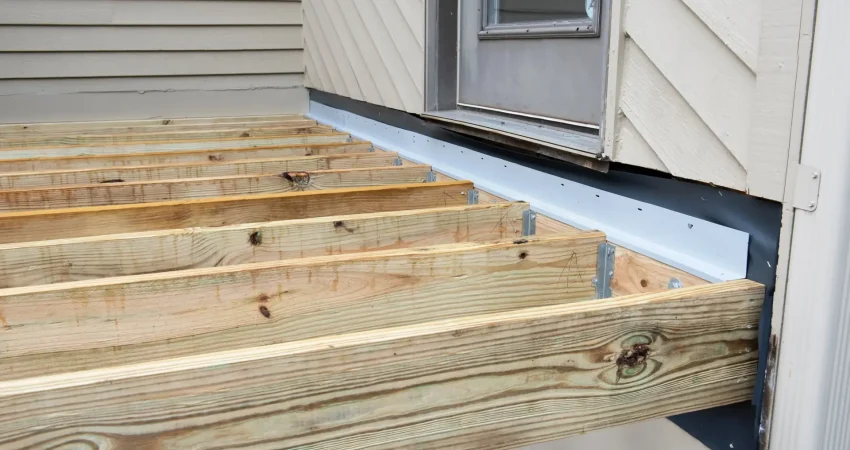
The ledger board is the long framing piece that attaches your deck directly to the side of your house. This is the single most critical connection on the entire structure. When older decks collapse, it’s usually because the ledger board pulls away from the home’s rim joist.
Look up at this connection point with your flashlight. You should see heavy-duty structural lag screws or through-bolts spaced evenly along the board. If you only see rusted nails holding the ledger to the house, your deck is unsafe. Nails don’t have the staying power to resist the outward pull of a heavy deck over time.
You also need to inspect the flashing, which is the metal or plastic cap that sits over the top of the ledger to redirect water away from the house. If the flashing is missing, damaged, or rusted out, rain has likely seeped behind the board. That rots the house’s framing structure, which is a massive safety hazard that requires a complete rebuild to fix properly.
Joist hanger and fastener inspection
Take a close look at the metal brackets holding the floor joists to the main beams and the ledger board. These are called joist hangers. Every single hole in that metal bracket should have a specific, thick hanger nail or structural screw driven into it. Many DIY builders make the mistake of using standard drywall screws or thin framing nails instead, which can snap under a heavy load.
Look for rust on these metal brackets and fasteners. If the hangers are heavily corroded or flaking, they’re losing their structural strength.
You should also check the connection between the main beams and the vertical support posts. The beam should sit directly on top of the post, secured with a heavy metal post-to-beam connector. If the beam is just bolted to the side of the post, the fasteners are carrying the entire weight of the deck instead of the wood column. Modern building codes don’t allow that because it puts too much stress on the bolts.
Railing and stair stability checks
The final part of your deck structural safety checklist focuses on the elements you touch every day. Walk up to the perimeter railing and push on the posts firmly. There should be almost no movement. Railing posts should be secured to the internal framing joists using heavy-duty bolts, not just nails driven through the outside face. If the railing wobbles when you lean on it, it won’t stop someone from falling during an accident.
Next, look at the stairs. Check the stringers, which are the diagonal boards that support the steps. Look at where the stringers attach to the deck frame. They should be secured with metal framing connectors, not just toe-nailed in place. Check the step treads for splits or sagging. If the stairs feel bouncy when you walk up them, the wood structure is wearing out and needs immediate attention.
Related Content:
Five ways to turn a standard composite deck into a custom outdoor space