
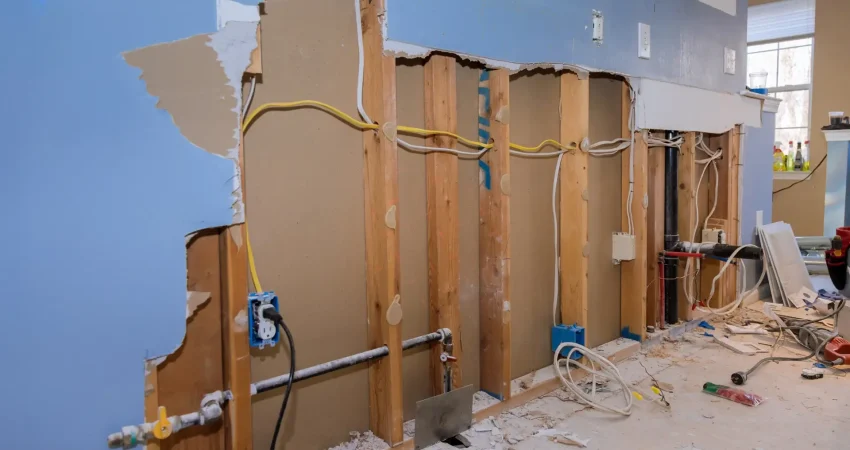
Home renovation television shows make tearing down a wall look incredibly simple. A host swings a sledgehammer a few times, the drywall falls away, and suddenly the dark kitchen is a bright, open space. In the TV world, the demolition is the easiest 15 minutes of the entire project. The real work starts when you have to deal with what was happening inside that wall.
Everyone wants an open concept kitchen remodel. However, you have to understand the structural and mechanical trade-offs that happen when you remove a major partition in your home. In many cases, it changes your storage footprint, your home’s skeletal structure, and your utility lines.
Supporting the roof
If the wall you want to remove runs perpendicular to your ceiling joists, it’s almost certainly a load-bearing wall. This means it’s actively supporting the weight of the floor above it or the roof structure. You can’t just remove it without replacing that support.
To keep your house from sagging, your build crew has to install a structural header. This is often a huge beam made from engineered lumber, like a Laminated Veneer Lumber (LVL) beam, or a heavy steel I-beam. You typically have two main design options for this beam.
A dropped header sits below the ceiling level, meaning you’ll see a wooden or drywall-wrapped beam running across the ceiling line where the old wall used to be. A flush header is cut up into the attic space or floor joists above. This allows your new kitchen ceiling to be completely flat from wall-to-wall. A flush header looks cleaner, but it requires significantly more framing work and labor to install.
You also have to look down. The weight that the wall used to support is now concentrated onto two specific points at the ends of the new beam. Moreover, that weight travels straight down to your basement or crawlspace. This often means adding new support posts and pouring concrete footings under the basement floor to safely handle the new load.
Hidden pipes and wires
Walls aren’t just there to hold up the ceiling. Instead, they act as utility highways for your home’s mechanical systems. When you open up a wall between a kitchen and a dining room, you’re almost always going to find a maze of infrastructure that has to be moved.
Electrical lines are the easiest to handle. An electrician can usually rerun wires through the ceiling or floor joists to keep outlets and switches up to building code.
Plumbing is much more complicated, especially in two-story homes. If you have a bathroom directly above your kitchen, the main waste stack—a thick three-inch or four-inch PVC or cast iron pipe—likely runs straight down the wall you want to remove. In addition, rerouting a main drain line requires cutting into flooring and joists. This can limit where your new upstairs plumbing fixtures can drain.
HVAC ductwork is another potential obstacle. Metal supply vents and cold air returns often run through interior walls to heat and cool the upper levels. Moving a duct means finding a new vertical path. You might need to build a small drywall soffit in a closet or a corner of the room to hide the new pipe.
Losing your wall storage
Tearing down a wall means losing a significant amount of vertical surface area. You’re giving up the space where your upper cabinets used to hang. If you remove an eight-foot section of wall, that’s eight linear feet of upper storage and eight linear feet of base cabinets gone, instantly.
An open concept kitchen remodel must compensate for this loss by expanding the footprint elsewhere. This is why a large central island is standard in open designs. The island replaces the lower cabinet storage and provides a beautiful new prep surface, but it has to work harder.
To make up for the lost upper cabinet storage, you need to rethink your remaining walls. Extending your cabinets all the way to the ceiling line adds valuable storage space for items you don’t use every day. Designing a dedicated, full-height pantry cabinet with pullout shelves can hold as many groceries and small appliances as an entire wall of traditional upper cabinets. Also, you have to balance the open look with smart, high-density storage choices so your new space stays clutter-free.
Ready to reimagine your kitchen with the experts at Kaz? We can’t wait to get started!
Related Content: